
The Zero Trust Data Gap: Closing the Blind Spot in Modern Security Architectures
Estimated reading time: 5 min read
The Zero Trust Data Gap leaves unstructured data exposed even in mature security environments, and FileFlex Enterprise closes this gap by enforcing continuous, least-privilege access and full visibility directly at the file level across hybrid, on-premises, and cloud repositories.
Introduction: Extending Zero Trust to Unstructured Data Across Hybrid Environments
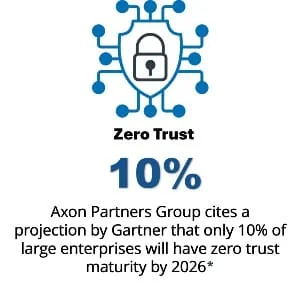
As organizations accelerate their adoption of Zero Trust architectures, many focus on strengthening identity, network, and application controls—but overlook the most critical layer of all: the data. Despite significant investment in Zero Trust tools and frameworks, unstructured data often remains exposed to implicit trust, uncontrolled movement, and limited visibility. This article explores the Zero Trust Maturity Model as defined by CISA, highlights the widespread gap in applying Zero Trust to the data layer, and explains how FileFlex Enterprise closes this gap by enforcing continuous verification and least-privilege access at the file level across hybrid, on-premises, and cloud environments.
The Zero Trust Maturity Model
The Zero Trust Maturity Model, as defined by the Cybersecurity and Infrastructure Security Agency (CISA), describes how organizations can progressively implement Zero Trust by evolving across three stages—Traditional, Advanced, and Optimal—across five key pillars: identity, devices, networks, applications/workloads, and data. In the Traditional stage, security is largely perimeter-based, relying on implicit trust, static controls, and limited visibility; identity and device authentication are basic, network segmentation is minimal, and data protections are inconsistent. As organizations move to the Advanced stage, they introduce more granular access controls, stronger identity verification, device health assessment, micro-segmentation, continuous monitoring, and policy enforcement that considers context such as user role, device posture, behavior, and risk.
In the Optimal stage, Zero Trust becomes fully dynamic and automated: identity and device trust are continuously revalidated, access decisions are adaptive and risk-based, telemetry is deeply integrated across the environment, and automated response mechanisms enforce policies in real time. At this level, organizations use sophisticated analytics, AI/ML, and unified visibility to ensure that no user, device, or application is ever trusted by default and that every interaction is continuously validated.
The Zero Trust Data Gap
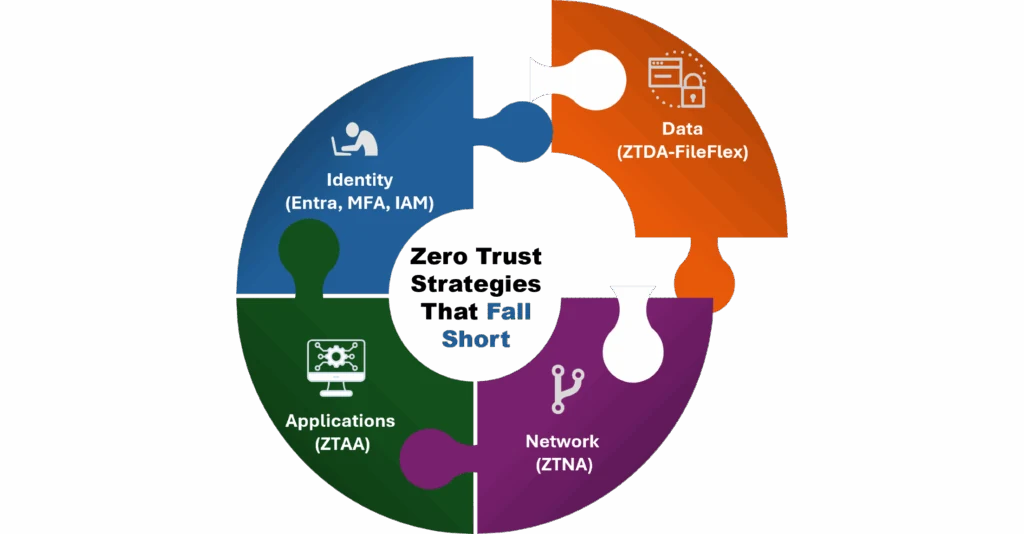
Many organizations make significant progress in their Zero Trust journey across identity, devices, networks, and applications, but they often leave a critical blind spot: the data layer itself. This gap exists because most Zero Trust programs focus on controlling who can access systems and how they access them, rather than controlling and monitoring access to the actual data objects—files, documents, and unstructured content—once access is granted.
In most environments, once a user is authenticated and authorized at the application or network level, they gain broad access to data repositories. At that point, traditional Zero Trust controls lose visibility: files can be copied, downloaded, forwarded, or shared through unmanaged channels like email, messaging apps, or external drives. This creates uncontrolled data sprawl and breaks Zero Trust’s core principle of “never trust, always verify.”
The CISA Zero Trust Maturity Model expects organizations to apply continuous validation and least-privilege controls all the way down to the data itself, but many organizations stop at the application boundary. They rely on perimeter tools, endpoint agents, and identity solutions—yet none of those enforce Zero Trust at the level where risk is highest: file access, file movement, file sharing, and file governance.
As a result, organizations can appear “mature” in Zero Trust across several pillars while still having a major gap in protecting unstructured data. Closing this gap requires adopting tools and architectures that enforce Zero Trust directly on data repositories, eliminate uncontrolled copying or syncing, provide granular policy-based access, and continuously verify every interaction with the data—not just the user or device accessing it. This is the missing layer that completes a true end-to-end Zero Trust architecture.
How to Address the Zero Trust Data Gap
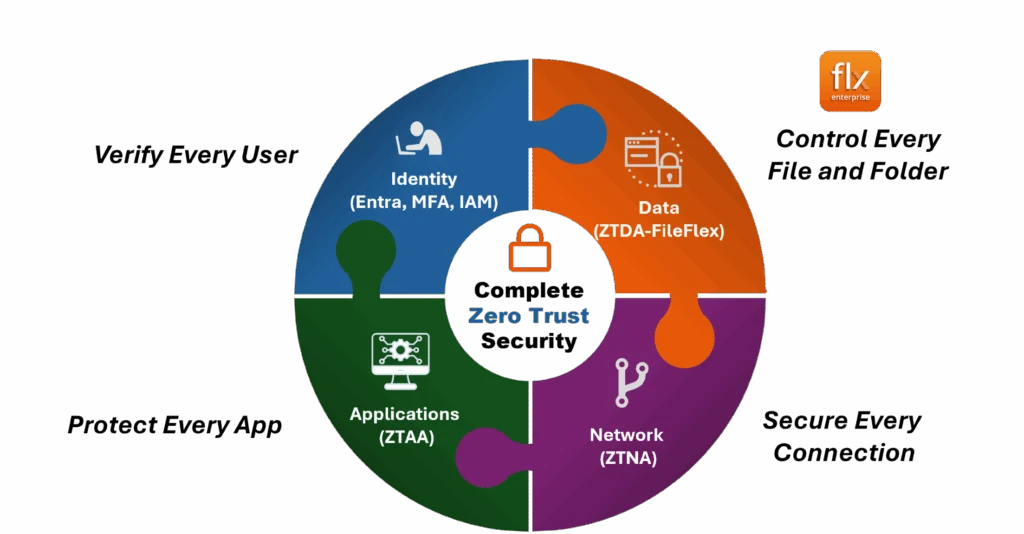
FileFlex Enterprise uses its patented zero trust data access architecture to directly address the Zero Trust data-layer gap by extending Zero Trust principles—continuous verification, least privilege, and explicit access—down to the individual file or folder, no matter where that data resides. Most organizations protect networks, identities, and applications, but still implicitly trust users once they reach the data. FileFlex eliminates that implicit trust by enforcing Zero Trust at the data interaction level itself.
Here’s how FileFlex Enterprise closes the gap:
- Zero Trust Policies Applied Directly to Data Repositories — FileFlex Enterprise connects to on-premises and cloud storage without copying, syncing, or centralizing data. Instead, it creates a secure, policy-controlled access layer on top of existing repositories. This means the organization can enforce Zero Trust controls—identity verification, device posture checks, role-based rules, context-based decisions—at the moment a file is accessed, regardless of where it lives.
- No Implicit Trust After Authentication — Even if a user authenticates successfully through an identity provider or reaches storage through a trusted network, FileFlex Enterprise still enforces explicit authorization for every file action. Every folder and file access is governed by granular policies and verified on each request.
- Eliminates Uncontrolled Data Movement — Traditional tools allow users to download or sync data to endpoints or cloud folders, which breaks Zero Trust. FileFlex Enterprise prevents this by using secure streaming of file operations, enabling users to view, edit, share, and collaborate without creating uncontrolled copies. This stops data sprawl and prevents leakage through shadow IT channels like email, cloud drives, or USB keys.
- Adds Continuous Monitoring and Auditability at the Data Layer — FileFlex Enterprise captures every file interaction—view, edit, share, create link, revoke link—providing a full audit trail at the data level. This meets CISA’s requirement for continuous diagnostics and enforcement, but applied specifically to unstructured data, where organizations typically lack visibility.
- Enforces Least Privilege on Data Access — Access can be restricted to individual files, folders, devices, and users. Users only see the data they are explicitly allowed to see; everything else is invisible. This granular control far exceeds what storage systems, VPNs, or file servers can offer natively.
- Integrates With Existing Zero Trust Infrastructure — FileFlex Enterprise does not replace identity, network, or endpoint solutions—it complements them. It leverages existing ZTNA, ZTAA, IDPs, SIEM/SOAR systems, and Zero Trust deployments to enforce consistent policies at the last mile: the data itself.
- Works Across Mixed, Hybrid, and On-Premises Environments — The data layer is complicated because organizations have NAS devices, on-prem file servers, SharePoint, FTP servers, cloud buckets, and legacy repositories. FileFlex Enterprise applies a unified Zero Trust access model across all of them—without migration and without disrupting workflows.
In Essence: Most organizations mature in Zero Trust everywhere except at the data layer. FileFlex Enterprise is purpose-built to close that final and most critical gap. It operationalizes Zero Trust at the file level, providing controlled, monitored, least-privilege access to unstructured data across the entire hybrid environment—completing an organization’s Zero Trust journey.
Conclusion: Achieving End-to-End Zero Trust Maturity
| Aspect | Current Challenge | FileFlex Enterprise Solution | Business Impact |
|---|---|---|---|
| Zero Trust Maturity | Organizations mature in identity, devices, networks, and apps but rarely at the data layer | Extends Zero Trust directly to files and folders across hybrid, on-premises, and cloud environments | Completes end-to-end Zero Trust, strengthening overall security posture |
| Data Layer Gap | Unstructured data can be copied, shared, or moved without control | Enforces continuous verification, least-privilege access, and secure streaming of file operations | Reduces risk of data breaches, uncontrolled sharing, and regulatory exposure |
| Visibility & Monitoring | Traditional tools lack file-level audit trails | Captures every file interaction with detailed logging and analytics | Enhances compliance, accountability, and operational insight |
| Integration | Many solutions require separate tools or disrupt workflows | Works with existing identity, ZTNA/ZTAA, and security infrastructure without migration | Maintains operational continuity while improving security |
| Hybrid & On-Premises | Data is scattered across NAS, file servers, SharePoint, FTP, cloud buckets, and legacy repositories | Applies a unified Zero Trust access model across all of them—without migration | Enables consistent governance across the entire hybrid environment |
Achieving true Zero Trust maturity requires more than securing identity, devices, networks, and applications—it requires extending the same principles down to the data itself. FileFlex Enterprise closes the long-standing Zero Trust Data Gap by enforcing continuous verification, least-privilege access, and full auditability at the file level, across every storage location.
For further reading see Federated Hybrid Access: Why Modern Organizations Can’t Afford to Ignore It and Zero Trust and Regulatory Compliance.
Learn More About FileFlex · Sign Up for a Free Trial
Related Reading
Frequently Asked Questions
- What is the Zero Trust Data Gap?
- The Zero Trust Data Gap is the blind spot left when organizations apply Zero Trust to identity, devices, networks, and applications, but not to the unstructured data itself—leaving files exposed once a user is authenticated.
- Why does the data layer matter for Zero Trust?
- Attackers target data, not networks. Without continuous, least-privilege controls at the file level, sensitive content can still be copied, downloaded, shared, or moved through unmanaged channels.
- How does FileFlex Enterprise close the gap?
- FileFlex applies Zero Trust policies directly to data repositories—identity verification, device posture checks, role-based rules, and granular permissions—on every file action, with no syncing or copying.
- Does FileFlex replace existing Zero Trust tools?
- No. FileFlex complements existing ZTNA, ZTAA, IDP, and SIEM/SOAR deployments by enforcing consistent Zero Trust policies at the last mile: the data itself.