
NIST SP 1800-35: How Data-Level Enforcement Strengthens Zero Trust Security
Estimated reading time: 6 min read
NIST SP 1800-35 provides practical, real-world guidance for implementing Zero Trust Architecture, highlighting that effective Zero Trust requires not only identity and network controls but also robust data-level enforcement to secure sensitive information across hybrid and distributed environments.
Introduction: Why Data-Level Security Is Now the Heart of Zero Trust
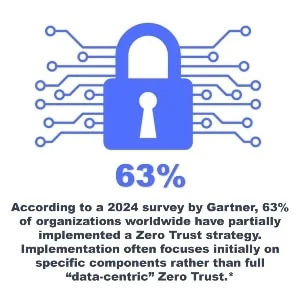
As organizations continue to navigate increasingly hybrid and distributed IT environments, the adoption of Zero Trust has grown rapidly—but often in a piecemeal, partial manner. According to a 2024 survey by Gartner, 63% of organizations worldwide have partially implemented a Zero Trust strategy, typically focusing on specific components such as cloud access, identity management, or VPN replacement. While these steps are important, many organizations have yet to implement full, data-centric Zero Trust, leaving critical gaps in data-level enforcement, micro-segmentation, and continuous monitoring. Recognizing this need, NIST published SP 1800-35, “Implementing a Zero Trust Architecture,” in June 2025, providing practical, real-world guidance to help organizations move beyond partial implementations and secure their most sensitive resources consistently across on-premises, cloud, and hybrid IT environments.
What’s New — A Practical, Real-World Zero-Trust Guide
Many organizations adopt Zero Trust in pieces—securing cloud access or identities—while leaving data itself exposed. SP 1800-35 shows how to move beyond partial deployments, applying Zero Trust directly at the data level. The focus is on:
- Closing the Access-to-Data Gap across on-prem, cloud, and hybrid environments.
- Consistent, enforceable policies that control who can access what, when, and how.
- Seamless integration with existing security tools and IT infrastructure.
- Real-time visibility and auditability for compliance and governance.
The result: a practical, scalable framework that secures your most critical assets, not just the perimeter.
How the New NIST SP 1800-35 Guidance Relates to Prior NIST Zero-Trust Materials
The foundational conceptual model for zero trust is still defined in NIST SP 800-207, “Zero Trust Architecture,” published in 2020. This document remains the primary reference outlining the core principles and high-level architecture of ZTA. NIST SP 1800-35 builds on that foundation by providing concrete, real-world implementation guidance that translates theory into working architectures. It illustrates how to combine identity management, access controls, micro-segmentation, security enforcement, and hybrid cloud/on-prem integration into practical Zero Trust deployments.
Key Themes & Principles Reinforced by NIST SP 1800-35
1. Identity-Centric and Context-Aware Access
NIST SP 1800-35 emphasizes that all access must be authenticated, authorized, and continuously evaluated based on identity, device, workload, and context.
- Identity-first access: Every request is verified based on user and device identity.
- Contextual evaluation: Access decisions consider device posture, location, and risk signals.
- No implicit trust: Network location alone does not grant access.
2. Protection Across Hybrid and Distributed Environments
Zero Trust must work consistently across on-premises, cloud, and remote environments.
- Unified access control: Centralized management for all storage types and locations.
- Remote-friendly: Supports secure access for remote workers and branch offices without VPN dependency.
- Consistent policy enforcement: Applies the same rules across cloud, on-premises, and hybrid IT.
3. Resource-Specific Authorization
NIST guidance emphasizes authorization at the resource layer rather than the network.
- File- and folder-level control: Permissions enforced directly on the resource.
- Dynamic policy changes: Real-time updates to access rules without infrastructure changes.
- Minimized risk: Limits exposure even if a device or credential is compromised.
4. Micro-Segmentation and Least Privilege
Zero Trust requires fine-grained segmentation to reduce lateral movement and enforce least privilege.
- Data micro-perimeters: Each repository is isolated to prevent unauthorized lateral movement.
- Role-based access: Users receive only the minimum access necessary for their tasks.
- Data-centric segmentation: Security follows the data, not just the network.
5. Continuous Monitoring and Auditability
Ongoing monitoring, auditing, and anomaly detection are core requirements for Zero Trust.
- Full audit trails: Track file activity including uploads, downloads, previews, and sharing.
- Real-time alerts: Notify users of relevant events like file access or updates.
- Compliance-ready logs: Immutable records support incident response and regulatory requirements.
6. Direct Data Protection
Zero Trust must secure the data itself, not just the network or identity layer.
- Data-level enforcement: Policies applied directly to files, folders, and other resources.
- Persistent access control: Continuous evaluation of every access request at the resource level.
- Comprehensive visibility: Full tracking and monitoring to detect anomalous activity.
- Cross-environment protection: Secures data across on-premises, cloud, and hybrid storage.
- Regulatory alignment: Reduces risk of data exfiltration, unauthorized sharing, and compliance violations.
7. Practical, Off-the-Shelf Implementation
NIST demonstrates that Zero Trust can be implemented using commercially available technologies.
- Standardized deployment: Works with existing IAM, SIEM, storage, and security tools.
- No proprietary infrastructure required: Accelerates adoption and reduces complexity.
- Integration-ready: Compatible with modern cloud and on-premises IT environments.
How FileFlex Enterprise Aligns With the Latest NIST Zero Trust Guidance (2025 Update)
Based on NIST SP 1800-35 (2025) and NIST SP 800-207
NIST’s latest guidance emphasizes practical, real-world Zero Trust implementation, built on identity-based access, continuous verification, micro-segmentation, and minimizing implicit trust—especially for data distributed across hybrid environments.
FileFlex Enterprise aligns tightly with all of these pillars and extends them into the data layer, where NIST now emphasizes significant visibility and control gaps.
1. NIST: Zero Trust must be identity-centric and context-aware
FileFlex Enterprise Alignment
- Enforces identity-first access to all files and folders, regardless of storage location.
- Integrates with your existing IdP (Azure AD, Okta, AD, etc.) for continuous identity verification.
- Uses device authorization to further validate access.
- Ensures that no network location is ever implicitly trusted.
2. NIST: Zero Trust must extend into hybrid and distributed environments
FileFlex Enterprise Alignment
- Unified access control plane across all storage types: on-prem NAS, SAN, SharePoint, private cloud, object storage, and more.
- No VPN or network exposure required — aligns with NIST’s “replace implicit trust in network pathways.”
- Eliminates distributed silos by giving IT centralized visibility into how data is accessed everywhere.
3. NIST: Authorization should be resource-specific (not network-level)
FileFlex Enterprise Alignment
- Implements resource-level permissions for every file and folder.
- Access enforcement occurs at the data layer, not the network layer.
- Supports dynamic authorization, allowing IT to change permissions in real-time without reconfiguring infrastructure.
4. NIST: Micro-segmentation and least privilege must be applied consistently
FileFlex Enterprise Alignment
- Creates micro-perimeters around each data repository.
- Enforces least-privilege access rules based on identity and role.
- Prevents all lateral movement to storage systems — even if a device or credential is compromised.
- Unlike network segmentation, segmentation follows the data itself.
5. NIST: Continuous monitoring and auditability are mandatory
FileFlex Enterprise Alignment
- Provides full audit trails at the file level: open, preview, upload, download, share, permission changes, etc.
- Offers real-time user alerts for events relevant to them (e.g., file accessed, file updated, new document added).
- Immutable logs align with NIST guidance for compliance, incident response, and visibility.
- Ideal for regulated industries (finance, government, utilities, healthcare).
6. NIST: Zero Trust must protect data directly — not just networks
FileFlex Enterprise Alignment
- Provides Zero Trust Data Access (ZTDA): the missing layer below network and identity controls.
- Ensures that data is never exposed, moved, synchronized, or cached unless policy allows.
- Maintains data in its original storage location, reducing exfiltration and shadow copies.
- Enables Zero Trust Virtual Data Rooms — a NIST-aligned model for secure collaboration and workflow.
7. NIST: Architectures must be implementable with commercial, off-the-shelf tech
FileFlex Enterprise Alignment
- Deploys on standard VM infrastructure with straightforward integration.
- Works with existing IAM, SIEM, storage, and security stack (Cisco, Zscaler, Microsoft, etc.).
- No proprietary infrastructure and no need to replace existing systems — accelerates ZTA adoption.
Summary
| NIST Zero Trust Principle | FileFlex Enterprise Alignment |
|---|---|
| Protect all resources (data, apps, services, infrastructure) | Treats every file, folder, or dataset as a resource, securing on-prem, cloud, and hybrid storage. |
| Per-request, least-privilege access | Enforces identity- and policy-based authorization on every file action. |
| Continuous verification | Integrates with IdPs for ongoing identity and device validation; no implicit trust after login. |
| Resource-level (not network-level) authorization | Permissions enforced directly on files and folders, not on the network boundary. |
| Micro-segmentation and least privilege | Creates micro-perimeters around each data repository and follows the data, not the network. |
| Continuous monitoring and auditability | Full audit trails for open, preview, upload, download, share, and permission-change events. |
| Direct data protection | Provides Zero Trust Data Access (ZTDA) so data is never moved, synced, or cached unless policy allows. |
| Implementable with commercial, off-the-shelf tech | Deploys on standard VMs; works with existing IAM, SIEM, storage, and security stack. |
Conclusion: Securing Data, Securing the Future
NIST SP 1800-35 reinforces that effective Zero Trust requires more than identity and network controls—it demands data-level enforcement across hybrid and distributed environments. FileFlex Enterprise operationalizes that guidance by extending continuous verification, least privilege, micro-segmentation, and full auditability directly to the data layer, completing a true end-to-end Zero Trust architecture.
For related reading see The Zero Trust Data Gap and Zero Trust and Regulatory Compliance.
Learn More About FileFlex · Sign Up for a Free Trial
*Gartner via FileFlex coverage
Related Reading
Frequently Asked Questions
- What is NIST SP 1800-35?
- NIST SP 1800-35, published in June 2025, is a practical implementation guide for Zero Trust Architecture. It builds on the conceptual model in NIST SP 800-207 by showing how to combine identity, segmentation, and data-level controls in real-world deployments.
- Why is data-level enforcement important for Zero Trust?
- Most Zero Trust programs focus on identity, network, and application controls, leaving unstructured data exposed once a user is authenticated. Data-level enforcement applies continuous verification and least-privilege rules directly to files and folders.
- How does FileFlex Enterprise align with NIST SP 1800-35?
- FileFlex extends Zero Trust to the data layer with identity-first access, resource-level authorization, micro-segmentation around repositories, continuous auditability, and integration with existing IAM/SIEM stacks—without requiring proprietary infrastructure.
- Can NIST-aligned Zero Trust be implemented with off-the-shelf technology?
- Yes. NIST SP 1800-35 explicitly demonstrates Zero Trust using commercial products. FileFlex Enterprise deploys on standard VM infrastructure and integrates with existing IAM, SIEM, storage, and security systems.