
Example 01
An employee downloads confidential loan documents and emails them externally.
Organizations have invested heavily in Zero Trust technologies such as identity management, multi-factor authentication, endpoint security, and Zero Trust Network Access (ZTNA). Yet sensitive information continues to be:
The reality is simple: most Zero Trust architectures stop before they reach the data. FileFlex extends Zero Trust principles directly to the information organizations are trying to protect.
The Definition
Zero Trust Data Access (ZTDA) applies Zero Trust principles directly to data access, sharing and collaboration. Instead of trusting users after they successfully authenticate, ZTDA continuously enforces security controls whenever users access sensitive information.
The Gap
Many organizations have implemented MFA, Identity and Access Management, Endpoint Security, ZTNA and Network Segmentation. These technologies secure access to applications and networks — but once a user gains access, the data itself often becomes largely uncontrolled.
Example 01
An employee downloads confidential loan documents and emails them externally.

Example 02
A contractor accesses a file repository and copies information to an unmanaged device.

Example 03
A partner receives access to an entire folder when only one document was required.
The identity was verified. The network was secure. Yet the data remained vulnerable.
The Evolution
Zero Trust has matured in stages — and each stage moves trust enforcement closer to the data itself.
Traditional Security
Trust is granted after users enter the network.
First Generation Zero Trust
Trust is continuously evaluated.
Next Generation Zero Trust
Trust extends directly to information. This is Zero Trust Data Access.
The Architecture
Traditional models protect everything up to the data — but not the data itself. Zero Trust Data Access inserts continuous data access controls between the network and the data.
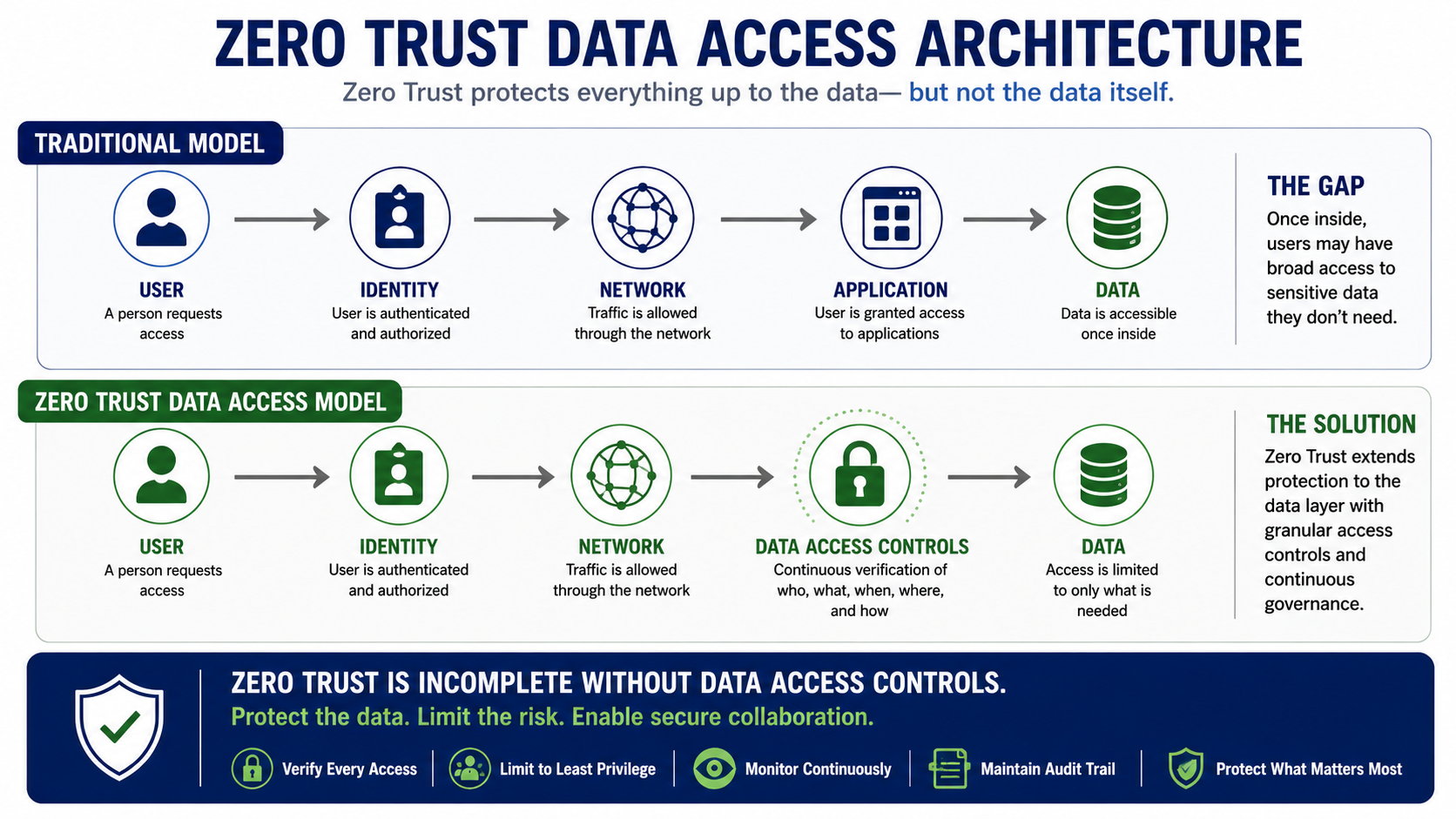
Zero Trust is incomplete without data access controls.
Standards Alignment
The ultimate goal of Zero Trust is not simply securing network connections — it is protecting organizational resources through continuous verification and policy enforcement. ZTDA directly supports key principles defined by the NIST Zero Trust framework.
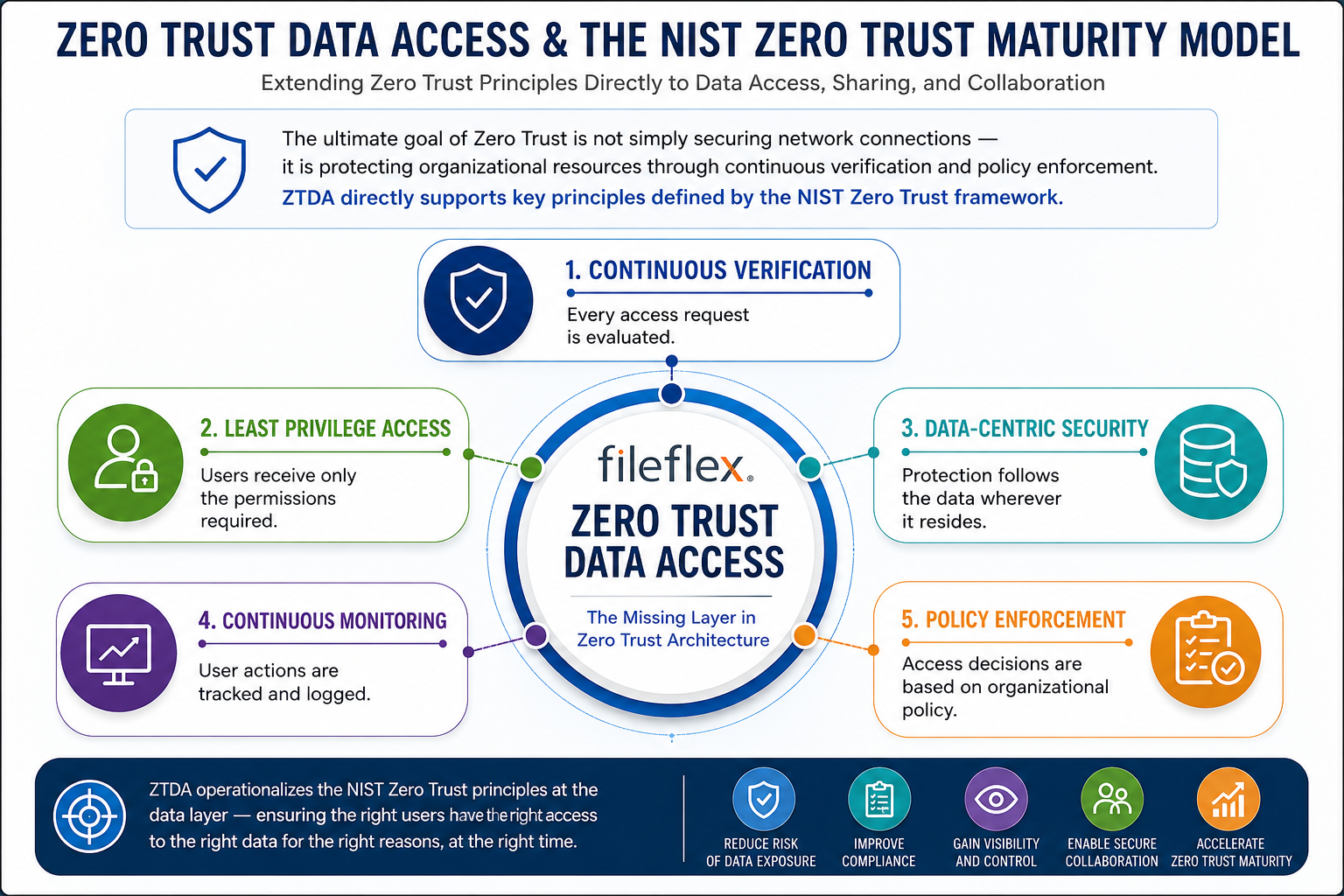
The Maturity Gap
Many organizations have progressed significantly across identity, network and endpoint maturity — yet remain early-stage where it matters most: the data.
Identity Maturity
Network Maturity
Endpoint Maturity
Data Access Maturity — Early Stage
ZTDA closes this gap.
The Capabilities
FileFlex provides organizations with the controls necessary to extend Zero Trust principles directly to data access and collaboration.
Access Control
Control who accesses information — at the file and folder level, adapted to each workflow.
Collaboration
Share data without email attachments — scoped, time-limited and fully controlled.
Auditability
Track every access event in an immutable, exportable record.
Sovereignty
Keep data under organizational control — files stay in your storage, under your governance.
Hybrid
Extend Zero Trust to on-premises storage, private cloud and hybrid environments.
Risk Reduction
Eliminate unnecessary data replication and exposure.
The Outcomes
Prevent uncontrolled file sharing.
Support requirements for financial services, privacy regulations and internal governance programs.
Enable secure collaboration without introducing additional storage silos.
Extend Zero Trust initiatives directly to the information layer.
The Security Stack
FileFlex does not replace your Zero Trust investments. It extends them to the data layer.
| Security Layer | Typical Solutions | FileFlex Role |
|---|---|---|
| Identity | Microsoft Entra, Okta | Complements |
| Endpoint | CrowdStrike, SentinelOne | Complements |
| Network | ZTNA Solutions | Complements |
| DSPM | Data Discovery & Classification | Complements |
| Storage | NAS, File Servers, Object Storage | Protects Access |
| Collaboration | Email & File Sharing | Secures Data Access |
Identity controls are essential. Network controls are essential. But neither protects data once access has been granted. Zero Trust Data Access closes the final gap by applying Zero Trust principles directly to information access, sharing and collaboration.