Security Built for Autonomous Threats — Not Yesterday's Perimeter

Get Zero Trust Data Access enforcement at the file layer, preventing unauthorized movement, sharing, and exfiltration of sensitive data — without copying it to the cloud.

Securing Files, Not Networks

The Threat Landscape

The Security Problem Has Changed

Traditional cybersecurity is no longer enough. AI-powered ransomware, autonomous exfiltration tools, and insider threats have shifted the battlefield: it's the data, not the infrastructure, that is most at risk.

  • Ransomware now targets files, not just endpoints or networks.
  • AI agents can scan, access, and move sensitive data autonomously.
  • Email and public links create uncontrolled data exfiltration paths.
  • Cloud-first file sharing often duplicates sensitive data into unknown locations.

The solution is not just more security controls. It's a data-centric approach that enforces Zero Trust at the file level.

Why Traditional Controls Are Insufficient

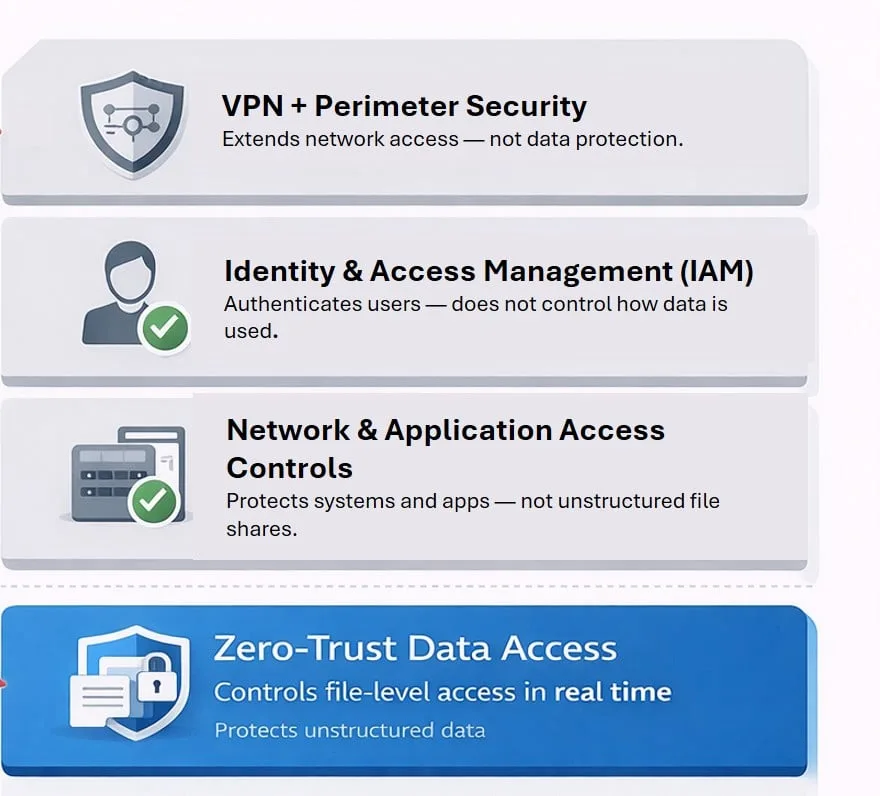
Chart showing how existing security tools leave the data layer unprotected
  • Zero Trust must extend to the data layer.
  • The data layer remains the blind spot.
  • This is where Zero-Trust Data Access must exist.

FileFlex Enterprise Works With Your Existing Ecosystem — Not Against It

Diagram showing the data access gap that FileFlex closes between identity, network, and data layers
  • Microsoft tools remain central to collaboration.
  • Identity platforms like Entra and Okta still manage authentication.
  • Your ZTNA platforms continue to enforce microsegmentation.
  • Your DSPM platform still identifies sensitive information.
  • FileFlex Enterprise sits at the data access boundary, closing gaps left by traditional security and cloud file-sharing.

The FileFlex Approach

Security Has Evolved. Your Architecture Must Too.

Traditional controls protect perimeters, identity, networks and applications. FileFlex Enterprise extends Zero Trust to the data layer.
Zero Trust Data Access

  • No public links
  • No anonymous access
  • Identity-bound access only
  • Policy-driven authorization

No Data Replication

  • Files remain on existing storage
  • No SaaS repository copy
  • Reduced attack surface
  • Data sovereignty preserved

Granular Policy Enforcement

  • Device-level authorization
  • Time-based access
  • Download restrictions
  • Sharing regulation
  • View-only enforcement

Full Auditability

  • Every access logged
  • Forensic visibility
  • Regulatory defensibility
  • Reduces compliance burden

Revitalized On-Prem Storage

  • Cloud-like functionality without duplicating files
  • Maintains data sovereignty
  • Reduces risk

Ecosystem Compatibility

  • Works with IAM platforms like Entra and Okta
  • Complements Illumio, Zscaler, Palo Alto, Cloudflare, Cisco
  • Supplements DSPM

Compliance Ready

Built for Regulated Environments

Protect Your Data Before It's Too Late

Stop ransomware, insider risk, and accidental leaks. Experience Zero-Trust Data Access today.

Book a Demo Launch a Pilot

Insights

Check Out These Related Blogs

Why Data Is Now the Real Target

AI-Driven Cybercrime at Zettabyte Scale

Zero Trust and Regulatory Compliance

Cloudflare One and FileFlex Enterprise—Securing Apps and Data Together

NIST SP 1800-35: How Data-Level Enforcement Strengthens Zero Trust Security

The Zero Trust Data Gap

SEC Cybersecurity Rules Driving Enterprise Security to Zero Trust Architecture: What CIOs and CISOs Need to Know

Hyperscaler Cloud Providers and the Data-Layer Gap: Extending Security with File-Level Control

Achieving End-to-End Zero Trust with Zscaler and FileFlex

Extending Cisco Zero Trust from Access to Data

Extending Microsoft Entra to Protect Your Data with Zero Trust Data Access

Top Reasons to Add Zero Trust Data Access to Palo Alto Cybersecurity

SharePoint Under Siege: Why Zero Trust Access Is Now Critical

European Health Data Space Compliance with Zero Trust

Why Microsoft-Centric Security Isn’t Enough: The Case for Zero Trust Data Access

From VPN Risk to Zero Trust Security: A Smarter Approach to Remote Access

The Zero Trust Maturity Model and the Role of ZTDA

How to Build a Complete Zero Trust Security Framework

UK iCloud Backdoor: Secure On‑Prem iCloud with ZTDA

Why a Zero Trust Data Access Decentralized Data Platform is Strategically Superior to Centralized Cloud File Access, Sharing and Collaboration

Top 10 Benefits of Restricting Direct Access to the Storage Infrastructure

Benefits of Zero Trust Least Privilege Access: 9 Key Reasons

Benefits of Zero Trust File Sharing Management: 6 Key Reasons

8 Benefits of Zero Trust Activity Monitoring

Zero Trust User Access Management: 4 Best Practices

Upholding Cybersecurity for Architects Through Zero Trust Data Access

Supporting Financial Services Cybersecurity Through Zero Trust Data Access

Zero Trust Cybersecurity for Credit Unions

Cybersecurity for Law Firms: The Priority of Zero Trust Data Access Security

How to Enforce Zero Trust Access Control to Mitigate Data Breach and Ransomware

Webinars

Watch Our Latest Zero Trust Webinars

Meeting NIST Standards for Zero Trust Data Access & Sharing

How Zero Trust Data Access Extends Office 365 Functionality into a Hybrid IT Infrastructure

Zero Trust Sharing of On-Premises Implementations of SharePoint

Securely Enable Your Remote Workforce with Zero Trust Data Access and no VPN

FAQ

Frequently Asked Questions

What is FileFlex Zero Trust Data Access (ZTDA)?

FileFlex Zero Trust Data Access is a data-centric security approach that enforces access controls directly at the file layer. It verifies every user, device, and request, applying least-privilege access without moving or copying data to the cloud, thereby reducing exposure and maintaining control over sensitive information.

How does FileFlex improve security compared to traditional cybersecurity approaches?

Traditional cybersecurity focuses on protecting networks, endpoints, and identities, but often leaves unstructured data exposed. FileFlex extends Zero Trust to the data layer, preventing unauthorized access, eliminating public links, enforcing identity-bound access, and reducing risks such as ransomware, insider threats, and data exfiltration.

Does FileFlex store or replicate data in the cloud?

No. FileFlex does not replicate or store data in the cloud. Files remain in their original storage locations, whether on-premises or in existing environments. This reduces the attack surface, preserves data sovereignty, and eliminates risks associated with duplicated data in third-party systems.

What security controls and capabilities does FileFlex provide?

FileFlex provides granular, policy-based controls including device-level authorization, time-based access, view-only restrictions, and download limitations. It also delivers full auditability with detailed logging of all access and sharing activity, enabling compliance, forensic visibility, and regulatory reporting.